Start your avalanche education journey today with our Free Avalanche Awareness Online Course

The Mountain Snowpack and Rounding

In the following video series, Jake Hutchinson talks through a variety of snow metamorphism processes. These videos take a deeper dive into snow formation and metamorphism that will help you build a solid foundation of understanding of snowpack development and evolution.

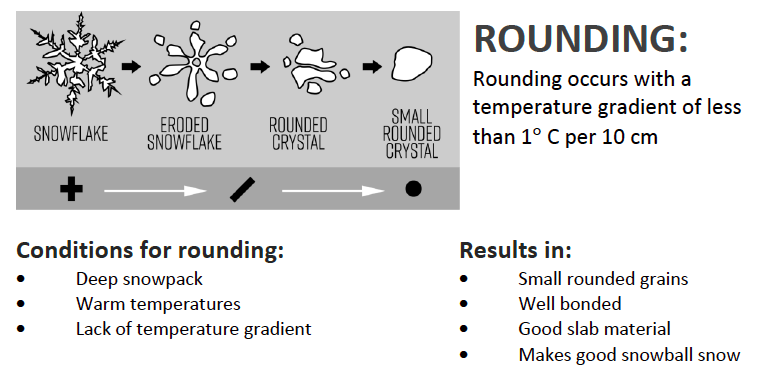
ROUNDING is a metamorphic process that can happen within the snowpack. Rounding occurs when there is a small temperature gradient in the snowpack. Rounding is a strengthening process.
https://vimeo.com/431619381/a92e684654

How to Identify Snow Crystals – Looking at Shape, Size, Layer Hardness and Weather History

The following video offers some tips and tricks for snow crystal ID. This is something that people often struggle with. The goal of this talk is to help you build a foundation before arriving at the course. This talk is also a helpful review of snowpack metamorphism.

After you watch this video, take time to practice crystal ID in the field, whether it’s in the backcountry, at the ski area, or out your front door.

Here is a link to the International Classification for Seasonal Snow on the Ground This link offers further descriptions for improved crystal ID, as well as additional photos.

Weather Observations for Professionals – How do you gather weather data both from a weather station and in the field?

Taking weather observations is an important part of forecasting. From collecting wind data to overnight snowfall, all of this information helps you build a better forecast.

AAI Instructor, Dave Kikkert, talks through how to take weather observations, how to record them, and where to find the information you need in the SWAG.

If you have a hard time remembering the shorthand documentation, you can find it in the SWAG, beginning on page 10.

It’s Time to Practice Using the AM Form. Join Don Carpenter to Fill One Out.

The AM form is a 3-page document. Don Carpenter is going to walk you through an exercise, completing an AM form, based on information from a day in the backcountry around Jackson, WY. In this three part video series, Don will present the information he uses to complete the forms. There will be downloadable links to each page of the AM form, as well as to the resources that Don presents. Take the time to complete each page and then check your completed AM Form against the answer key.

PART ONE RESOURCES:

Fill out PAGE 1 of the AM Form. You can download it below.

PART 2 RESOURCES:

Fill out PAGE 2 of the AM Form. You can download it below.

Fill out PAGE 3 of the AM Form. You can download it below.

Still Confused About Rating the Size of Avalanches? Here are Some Tips and Techniques Using a More Visual Method.

THE FOLLOWING VIDEO IS OPTIONAL, ADDITIONAL MATERIAL. CHECK IT OUT IF YOU ARE INTERESTED.

It can be hard to agree on how big an avalanche is. Is it a D2 or a D3? A D2.5. This video offers a method for more effectively sizing avalanches.

If you want to practice using this method, watch the following video. Some of these avalanches are tricky to rate, as the length and depth of the crown aren’t given, nor are the vertical fall of the avalanche or the depth of the debris. Don’t get discouraged. It’s good practice, and if you are rating an avalanche in the field, you will likely have more information to use. If you want to record your answers, feel free to use this google sheet. Make a copy in your drive (or download this one) in order to use it.

Common Professional Mistakes – Lessons from the Mountains

There have been numerous practitioners and researchers who have studied near misses and accidents in the snow and avalanche industry. Taking the time to understand these accidents and near misses is an opportunity to learn from others, and hopefully avoid making some of the same mistakes. Jake Hutchinson will walk you through some of the research, as well as a personal near miss, in this three part video series.

Here is Doug Richmond’s paper on Repeated Mistakes of Avalanche Professionals.

PART 2 OF COMMON PROFESSIONAL MISTAKES

You can find Ron Simenhois and Scott Savage’s paper on Professional Avalanche Worker’s Near Misses here.

You can find Ian McCammon’s Heuristic Traps paper here.

Interested in the Snowy Torrents? Find the publication here.

PART 3 OF COMMON PROFESSIONAL MISTAKES

You can find Roger Atkin’s Mindset paper here.

Here’s another talk about Personal Disaster Flags by Don Sharaf.

Want to learn more about situational awareness. Left of Bang is a book that discusses situational awareness levels.

How to Document Avalanches and Communicate Your Observations

As a professional, it is important to be able to communicate about avalanche activity – how big an avalanche was, what started it, where it was.

Avalanches are typically documented in the order: TYPE, TRIGGER, SIZE, BED SURFACE.

This video will walk you through the basics of avalanche classification and documentation.

It can be hard to remember all of these symbols and short hand documentation. Use the Snow, Weather and Avalanche Guidelines (SWAG) as a study guide. Page 50 is where the avalanche observations section starts.

Write important things in the back of your field book. LEAST is a good reminder for what to communicate on the radio. Location, Elevation, Aspect, Slope Angle, Time/Date of Occurrence (or Trouble/Tests for snow pits)

An Opportunity to Practice Documentation – A Scribing Exercise

Don Sharaf is going to run you through a scribing exercise that you can self-correct at the end of the video. A likely scenario for when you might have to scribe would be touring with a partner and only wanting to expose one person to the slope where you are digging. Your partner goes on to the slope to dig and dictates their findings back to you.

Understanding Snow Pit Documentation

Understanding how to document field observations and snow pits is an essential skill as a professional.

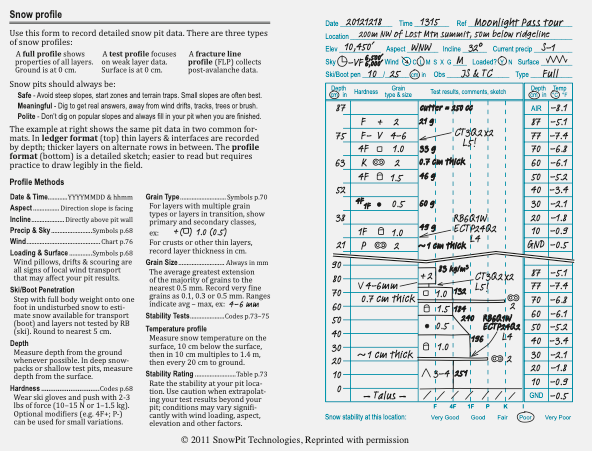
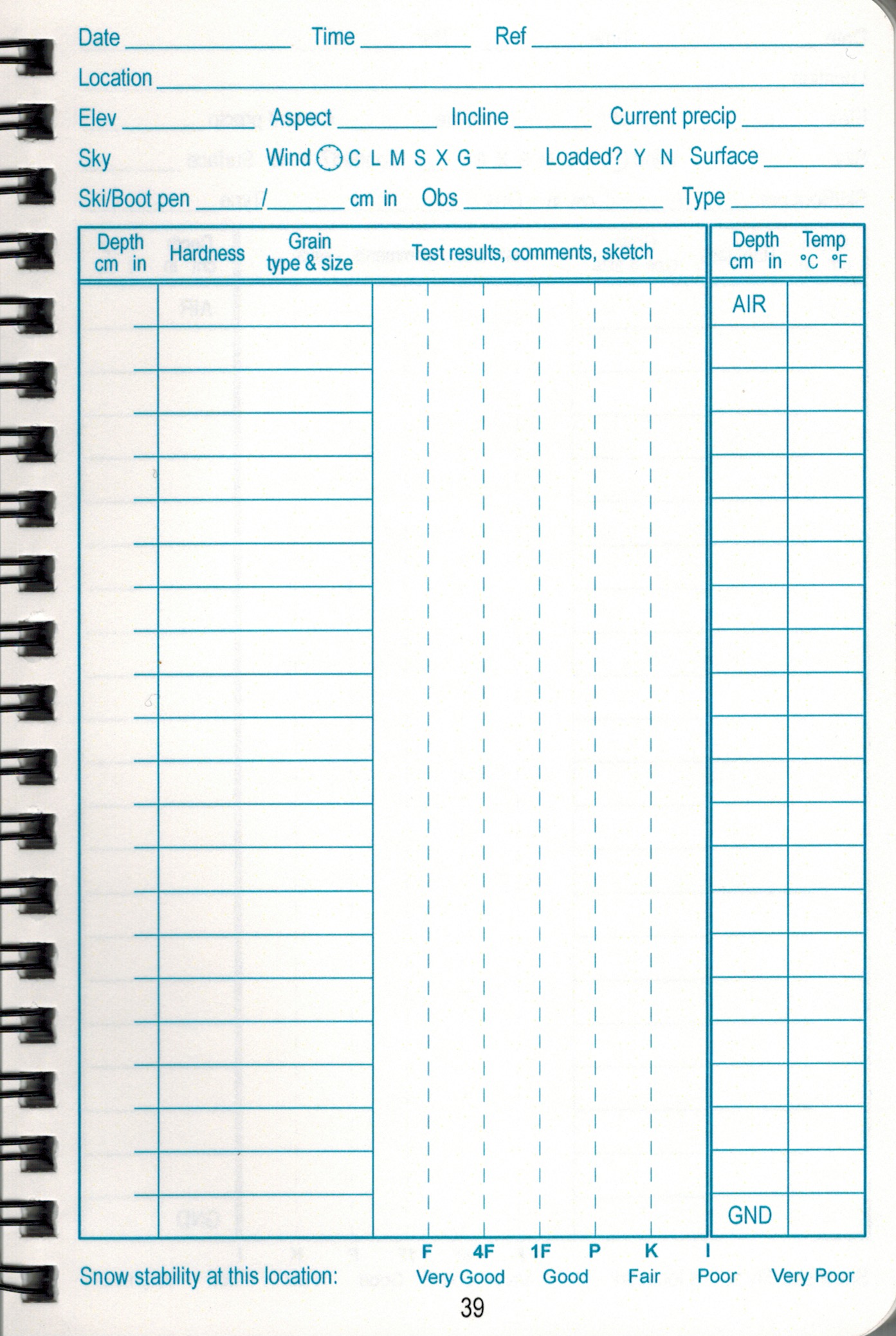
In this video, Don Sharaf will talk through how to document a snow pit, beginning with the header information, all the way through identifying layers and doing stability tests. It’s important to document the pits you dig as a professional, in order to track layers throughout the season, as well as to have a written record of snowpack investigation.

If you’re using a field book that has a reference section with symbols and other pit documentation tips, use a paper clip to mark where those reference sections are for easy access.

And if you want to study the short hand documentation, study the SWAG, pages 10-20 for weather observations and pages 20-39 for snowpack and stability test documentation.